
As reliance on these systems continues to grow, so too does the impact of downtime. In environments where operational continuity is essential, resilience must become a fundamental design principle rather than an afterthought.
Historically, many security systems were designed with a primary focus on functionality. Resilience was often considered later in the project lifecycle, typically addressed through additional hardware or backup components.
However, modern security platforms are increasingly complex and highly integrated, connecting technologies such as access control, video surveillance, perimeter detection, alarm monitoring, and analytics. These interconnected systems introduce new dependencies that can increase the risk of disruption if resilience is not considered from the outset.
Designing for resilience therefore requires a shift in mindset, from specifying individual technologies to designing a system architecture that supports long-term operational continuity.
Achieving resilience is not the result of a single design decision. Instead, it must be considered throughout the entire system lifecycle.
From the initial concept and risk assessment through to system deployment and live operation, each stage introduces potential risks to system availability. Architecture decisions made early in the design process often determine how effectively a system can continue operating during hardware failure, network disruption, or software faults.
By treating resilience as a lifecycle principle, organisations can reduce the likelihood of single points of failure and ensure that systems remain operational during unexpected events.
At the heart of resilient security systems is a well-designed architecture.
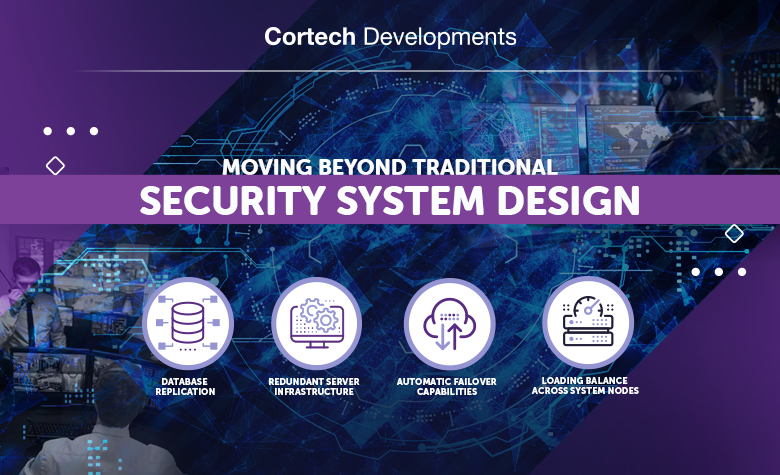
Traditional single-server systems are increasingly being replaced by distributed platforms that allow processing and services to operate across multiple nodes. This approach reduces reliance on any single component and enables systems to maintain functionality even when individual elements fail.
Key architectural considerations for resilient systems include:
These design strategies help ensure that if one component becomes unavailable, another can take over with minimal disruption.
While resilient software architecture plays a critical role, it cannot operate effectively without the right infrastructure.
Security systems now process large volumes of data, particularly in environments where video analytics and advanced monitoring capabilities are deployed. These workloads place significant demands on underlying hardware platforms.
Infrastructure designed specifically for security applications must therefore support continuous operation through features such as redundant power supplies, resilient storage systems, and secure operating environments.
Without this foundation, even the most advanced software platforms may struggle to deliver the availability required in critical environments.
Integration has become a defining characteristic of modern security platforms. Bringing together multiple technologies allows organisations to create more intelligent and responsive systems, but it also introduces new challenges.
If integrations are not designed carefully, a failure within one subsystem can potentially impact the wider platform. This makes robust integration design an essential part of resilience planning.
Best practice approaches include the use of open APIs, fault-tolerant communication methods, and architectures that allow individual subsystems to continue operating independently if another component fails.
Resilient system design rarely happens in isolation. It requires collaboration between consultants, system integrators, software developers, and infrastructure specialists.
When these disciplines work together during the design stage, it becomes far easier to align system architecture, infrastructure capacity, and integration strategies. This collaborative approach helps identify potential risks early and ensures that resilience is embedded into the overall system design.
Security systems deployed in critical environments are often expected to remain operational for many years. As a result, specifications should account not only for current requirements but also for future expansion and evolving operational needs.
Designing with long-term resilience in mind allows organisations to adapt their systems as technologies change while maintaining operational stability.
In an increasingly interconnected world, resilience is no longer simply a desirable feature. For critical environments, it has become a fundamental requirement.
