
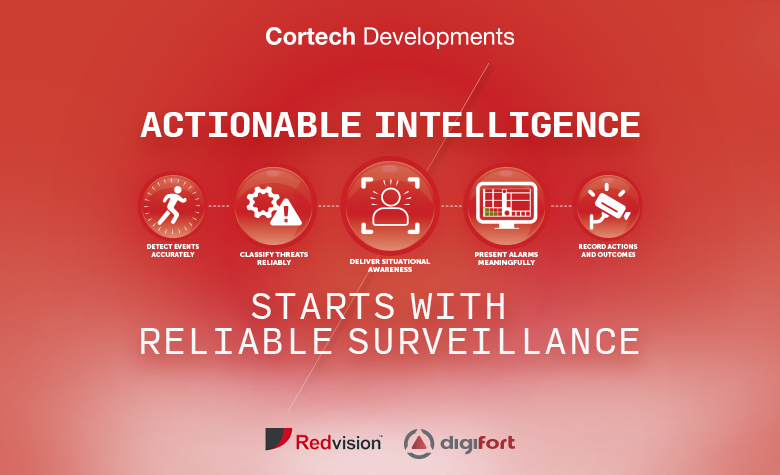
The event explored how advances in Artificial Intelligence, video analytics, integrated surveillance, and intelligent alarm management are helping organisations move beyond passive monitoring towards proactive operational response.
But perhaps the most important takeaway from the day was this: Actionable intelligence is not created by a single technology.
It is created when multiple technologies work together cohesively to help operators make faster, more informed decisions.
And in today’s increasingly complex threat landscape, that joined-up approach matters more than ever.
Across critical infrastructure, utilities, custodial environments, transportation, and other high-security sectors, organisations are under growing pressure to improve both security resilience and operational efficiency.
At the same time, the threat landscape continues to evolve.
Perimeter intrusion is no longer limited to traditional physical breaches. Security teams must now consider increasingly sophisticated threats ranging from coordinated intrusion attempts and organised criminal activity through to drone-based reconnaissance and wider infrastructure disruption. While surveillance technologies have advanced significantly, many organisations still face a familiar challenge:
The focus must now shift towards how systems interpret, prioritise, contextualise, and ultimately support response.
Effective operational response begins with reliable detection. No analytics platform, AI engine, or workflow automation can compensate for poor image quality or inconsistent surveillance coverage.
This is why the foundations of perimeter security still matter enormously.
Camera positioning, low-light performance, environmental resilience, field of view, optical clarity, and mechanical reliability all directly influence how effectively a threat can be identified and classified.
In mission-critical environments, maintaining confidence in the surveillance layer is essential, particularly where operators are required to make rapid decisions under pressure.
This is where integrated solutions can deliver significant operational benefits.
By combining ruggedised surveillance technologies with intelligent management and alarm handling platforms, organisations can create a far more cohesive and resilient operational picture, reducing the disconnect that often exists between detection, verification, and response.
One of the biggest misconceptions surrounding AI in security is that analytics alone provide intelligence. In reality, analytics are only one part of the wider decision-making process.
True actionable intelligence occurs when systems are capable of:
This requires far more than standalone devices or isolated software platforms. It requires collaboration between surveillance, analytics, alarm management, workflow logic, and human operators.
Increasingly, security operators need systems that do not simply generate alerts, but actively help them understand:
This shift from “monitoring” to “decision support” is redefining modern control room operations.
As organisations continue investing in AI-powered surveillance and analytics, integration is becoming one of the most important considerations in long-term system design.
Security systems can no longer operate effectively in silos.
Video surveillance, perimeter detection, analytics, access control, audio, and operational workflows must increasingly function as part of a unified operational ecosystem.
This integrated approach enables organisations to achieve far greater operational efficiency and situational awareness. For example:
When technologies are designed to work together seamlessly, organisations are able to reduce response times, minimise nuisance alarms, and improve operational consistency across the entire security environment.
Despite the continued growth of AI within security, human decision-making remains central to effective incident response.
The role of technology should be to enhance operators, not overwhelm them.
Modern control rooms are increasingly complex environments where operators may be responsible for managing multiple systems simultaneously. Without intelligent alarm handling and contextual presentation, even advanced technologies can contribute to operator fatigue.
This is why workflow-driven interfaces, intelligent alarm management, and clear situational awareness tools are becoming essential components of modern security strategies.
The combination of advanced surveillance technologies and intelligent integration platforms enables operators to move from simply reacting to alarms towards managing incidents with greater confidence, clarity, and consistency.
As the industry continues to embrace AI, automation, and advanced analytics, there is a growing recognition that no single technology provides the complete answer.
Real operational resilience comes from adopting a holistic approach. where surveillance, detection, software intelligence, and operational workflows are designed together rather than deployed independently.
This collaborative philosophy is increasingly helping organisations across critical sectors build security environments that are not only more intelligent, but also more operationally effective.
Because ultimately, the goal is not simply to collect more data.
The goal is to enable better decisions.
And that is the true meaning of actionable intelligence.
This event brought together expertise across integrated security software, ruggedised surveillance technology, and intelligent VMS solutions through collaboration between Cortech Developments, Redvision, and, helping demonstrate how joined-up technologies can better support actionable intelligence in high-security environments.
