
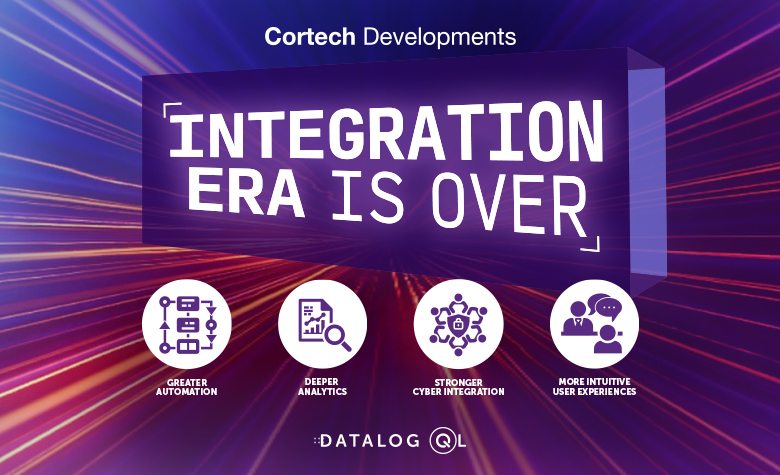
Across critical infrastructure, utilities, healthcare, and data centres, security environments have become more complex, more regulated, and more exposed to risk than ever before. Systems are no longer isolated. Threats are no longer purely physical. And the volume of data being generated is growing exponentially. In this new landscape, simply connecting systems doesn’t solve the problem. Because visibility without understanding is not control.
Many platforms in the market, particularly those positioned as PSIM or unified security systems, excel at aggregation. They bring together multiple technologies into a single interface and allow operators to respond to alarms as they occur. Some go further, adding workflows or standard operating procedures to guide responses. But beneath the surface, a fundamental limitation remains: most platforms are still event-driven, not data-driven. They react to what’s happening in the moment but lack the underlying structure to:
In other words, they help operators see what’s happening but not necessarily understand it. And in high-security environments, that distinction matters.
To meet modern demands, security platforms must evolve beyond integration into something more powerful. Operational intelligence systems. This shift is subtle, but significant. An operational intelligence platform doesn’t just connect systems. It:
This is the difference between:
At the heart of this evolution is something often overlooked in security conversations: data architecture. As systems scale, the ability to manage, query, and secure data becomes critical. Without a robust underlying data model, organisations face challenges such as:
By contrast, platforms built on structured, queryable databases, such as SQL-based architectures, offer a fundamentally different level of capability. They allow organisations to:
In essence, they turn raw data into actionable intelligence.
Another critical shift shaping the industry is the convergence of physical and cyber security. Traditionally, these domains operated independently. Physical security systems were deployed, integrated, and managed with limited consideration for cyber risk. That is no longer viable.
Today’s security platforms sit at the heart of critical infrastructure. They connect to networks, integrate with IT systems, and process sensitive operational data. As a result, they represent a potential attack surface. This makes cyber security a foundational requirement, not an optional add-on. Platforms must be designed with:
Crucially, this security must be built in from the ground up. Because retrofitting cyber protections onto an existing platform is rarely sufficient in high-risk environments.
As platforms evolve, so too does the role of the operator. In traditional control rooms, operators are often reactive. They monitor screens, respond to alarms, and follow procedures when incidents occur. But as environments become more complex, this model breaks down. Operators are faced with:
Without the right tools, this can lead to:
Operational intelligence platforms address this by shifting the burden away from the operator. Instead of simply presenting information, they:
The result is a more confident, effective response, especially in high-pressure situations.
Another defining characteristic of modern security environments is scale. Organisations are no longer managing a single site or facility. They are responsible for entire estates, often spanning multiple locations, regions, or even countries. This introduces new challenges:
In this context, security platforms must move beyond the control room. They must provide:
This is where dashboards, data visualisation, and structured reporting become essential, not just for operators, but for decision-makers across the organisation.
This is the philosophy behind Cortech’s approach with Datalog QL. Rather than starting with integration and layering functionality on top, Datalog QL has been designed as a secure, data-driven platform from the ground up. Its core principles reflect the needs of modern, high-security environments:
The need for this evolution is being driven by real-world pressures. Organisations are facing:
In this environment, the limitations of traditional platforms become more apparent. Integration is no longer the differentiator it once was. Instead, the focus is shifting towards:
Looking ahead, the direction of travel is clear. Security platforms will continue to evolve towards:
But at the core of this evolution will remain one fundamental principle, the ability to turn data into intelligence. Because ultimately, the goal of any security system is not just to detect events, but to enable the right response, at the right time, with complete confidence.
The security industry has come a long way. From standalone systems to integrated platforms, and now towards operational intelligence. Each step has delivered new capabilities but also revealed new challenges.
Today, the question is no longer: “Can your systems work together?” It’s: “Can your platform give you the insight, control, and confidence you need to protect your organisation?”
For those operating in high-security, high-risk environments, the answer to that question has never been more important. And it’s why the next generation of platforms must go beyond integration, towards something smarter, more secure, and fundamentally more capable.
