
While this information has the potential to improve security and operational performance, it also presents a significant challenge: alarm fatigue.
When operators are faced with hundreds or even thousands of alerts each day, identifying genuine incidents quickly becomes increasingly difficult.
Critical alarms can be overlooked, response times can increase, and operational effectiveness can suffer.
Alarm fatigue occurs when operators become overwhelmed by the volume of events generated across multiple systems. Common challenges include:
Over time, operators can become desensitised to alerts, increasing the likelihood that important events are not recognised quickly enough. In high-security and mission-critical environments, this presents a significant operational risk.
A common misconception is that more technology automatically creates a safer environment. While additional sensors, cameras, and monitoring systems can increase visibility, they also generate greater volumes of information.
Without effective management, operators may spend more time investigating alarms than responding to incidents.
As security environments become increasingly connected, organisations must focus not only on collecting information but also on managing it effectively.
An isolated alarm rarely tells the complete story. A forced-door alarm, for example, could indicate a security breach, a maintenance activity, or an authorised contractor working outside normal operating hours.
Without additional context, determining the appropriate response can be difficult.
When alarm data is combined with access control events, CCTV footage, site maps, procedures, and operational information, a much clearer picture emerges.
Context transforms alerts into intelligence.
Rather than reacting to individual alarms, operators can understand the wider situation and prioritise their response accordingly.
The objective of modern security management is not simply to collect information but to deliver meaningful intelligence to the right people at the right time.
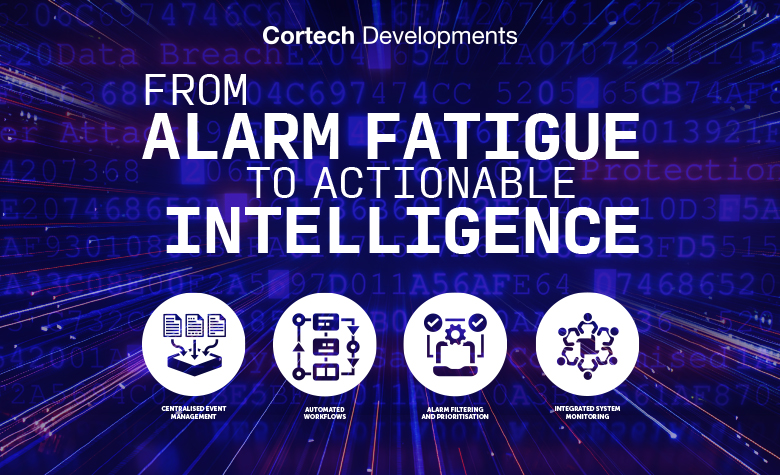
This can be achieved through:
By presenting relevant information within a single operational environment, organisations can reduce operator workload while improving decision-making.
Operational resilience depends on an organisation’s ability to detect, assess, and respond to incidents effectively.
When operators have access to accurate, contextual information, they can make faster decisions, coordinate responses more efficiently, and maintain operational continuity during disruptive events.
This is particularly important across critical infrastructure, healthcare, utilities, transport networks, custodial environments, and data centres, where the consequences of disruption can be significant.
As operational environments become increasingly connected, the organisations that gain the greatest value from technology will be those that can transform information into insight and insight into action.
By integrating systems, providing context, and delivering actionable intelligence, organisations can reduce alarm fatigue, improve decision-making, and strengthen operational resilience.
In an environment where every second matters, the ability to focus on the information that truly requires attention can make all the difference.
